
Proudly Serving the Rock Hill, Charlotte, and Surrounding Areas


How to Service a Tankless Water Heater in Charlotte, NC
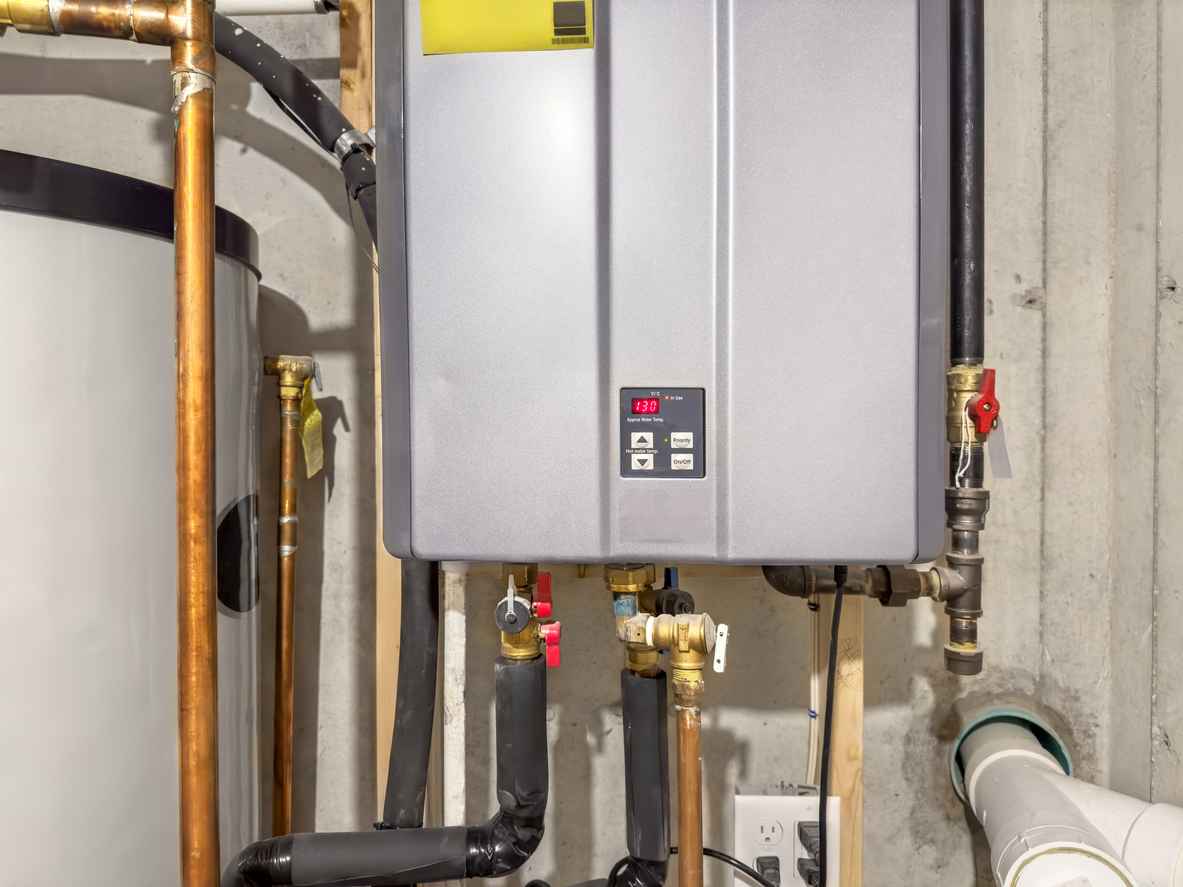
If you own a tankless water heater in Charlotte, or you are doing research before buying, here’s the short version: annual service is not optional. The Charlotte-Mecklenburg closed-loop water system delivers water that carries dissolved calcium and magnesium, the minerals that destroy your heat exchanger from the inside out. This guide breaks down exactly what professional service includes, what it costs, DIY cost, and why one popular option that companies use as a selling point, the inline descaler, gives homeowners a false sense of security.
What Does Tankless Water Heater Service Cost in Charlotte?
Most Charlotte homeowners pay $300 to $400 for a complete professional service visit. Here’s what drives that range:
| DIY | $150-$250 |
| Full service + filter clean + inspection | $250 – $400 |
| Full service + error code diagnosis | $350 – $600 |
| Service + parts (flow sensor, igniter, etc.) | $350 – $600+ |
How we got these numbers: As a licensed plumbing company operating a fleet of trucks across Mecklenburg County and surrounding areas, we don’t pull numbers from national
websites that offer low price ranges, so you’ll submit your information. These ranges reflect local data and actual jobs we have completed for Charlotte-area homeowners, real quotes, real invoices, and real labor rates in this market.
Care Club members pay less on every visit: Our Care Club members receive 10% off all services and repairs. Lifetime Care Club members save 15%. More on that in the membership section below.
Why Do Charlotte Homeowners Need to Service Their Tankless?
Here’s something most plumbing websites won’t say directly: your zip code affects how fast your tankless unit breaks down.
Charlotte operates a closed-loop municipal water system drawing primarily from the Catawba River. That water is treated, safe to drink, and has a lower mineral content. But dissolved calcium and magnesium still move through your pipes and, over time, coat the interior walls of your tankless unit’s heat exchanger with a hard, white crust called scale.
Scale is to a tankless water heater what plaque is to arteries. It doesn’t cause a crisis overnight. But over time, it reduces efficiency, drives up your energy bill, and can eventually cause the heat exchanger to crack or fail, a repair that can run $1,000 or more, or force a
full unit replacement.
When scale builds up, here’s what you start noticing:
- Hot water takes longer to arrive at the faucet.
- Flow rate drops noticeably when running multiple fixtures.
- Water temperature fluctuates during showers.
- Error codes appear on the unit’s control panel (common on Rinnai, Navien, and Noritz units)
- Energy bills creep up for no obvious reason.
In Charlotte’s water conditions, most manufacturers’ recommended 2-year service intervals are too long. We recommend annual descaling for homes without a water softener upstream of the unit.
What a Professional Tankless Service Actually Includes
Not all service visits are equal. Here are the six steps a complete, professional service should cover. Ask any company you call whether they perform all of them. Not descaling the unit long enough or not cleaning the filters is setting you up for failure down the road.
1. Inlet Filter Screen Cleaning
Your unit has small mesh screens on the cold-water inlet that trap sediment before it enters the heat exchanger. Charlotte’s municipal water carries enough fine particulate that these screens clog faster than homeowners expect. A clogged screen reduces flow and can trigger lukewarm water or “cold sandwich” events, which are bursts of cold water mid-shower. Cleaning takes 10 minutes and makes an immediate difference.
2. Heat Exchanger Descale (The Critical Step)
The technician shuts off the gas and cold-water supply, connects a circulation pump and hoses to the service ports, and runs a food-grade descaling solution through the heat exchanger for 45 to 90 minutes. This dissolves the mineral scale. The system is then flushed with clean water until the output runs completely clear. In Charlotte, this step alone justifies the annual service cost.
3. Burner Assembly Inspection
The technician visually inspects the burner and combustion chamber for carbon buildup, cracks, and corrosion. A dirty burner operates less efficiently, leading to short-cycling or tepid water. This inspection also catches early signs of gas valve wear before it becomes an emergency.
4. Venting Inspection
Blocked or damaged venting is a safety issue, not just a performance issue. The technician checks accessible intake and exhaust venting for obstructions, condensation buildup, and proper sealing. This is required under Charlotte-Mecklenburg building and safety codes for gas appliances.
5. Error Code Diagnosis
If your unit is throwing a fault code, the technician pulls it, interprets it, and diagnoses it. On most Rinnai, Navien, and Noritz units, common codes indicate scale buildup, ignition failures, or flow sensor issues, all of which are caught and addressed during a proper service visit.
6. Temperature and Pressure Verification
The technician confirms your outlet temperature is correctly set, most Charlotte homes should be at 120°F, and checks that your cold-water inlet pressure falls within safe operating range for a tankless (15 to 150 PSI). High water pressure is a leading driver of premature plumbing fixture failure in Mecklenburg County homes, particularly in neighborhoods served by older distribution lines. Your home’s pressure should be 80 PSI or less.
How the Descale Flush Actually Works: Step by Step
The descale flush is the core of any tankless service visit. Here’s exactly what a technician does, and what you should expect if you’re watching, planning to tackle it yourself.
How Long Does it Take?
A full descale flush takes 60 minutes from start to finish. Any technician who’s in and out in 30 minutes did not complete a proper flush. The descaling solution needs time to circulate and dissolve mineral deposits; rushing it defeats the purpose.
What the Technician Uses
Two things are required that you may, or may not, have on hand: a submersible circulation pump (to continuously push the solution through the heat exchanger) and a food-grade descaling solution, usually a purpose-made citric acid concentrate. Never use harsh
chemical descalers not rated for potable water systems. In a Charlotte home, a citric acid solution tends to outperform straight vinegar because it works faster at lower concentrations against calcium carbonate scale.
1. Shut Off the Gas and Cold-Water Supply
The technician turns off the gas supply valve to the unit and closes the cold-water isolation valve on the inlet. This stops water from entering the unit and prevents gas from firing during service. Most tankless units have dedicated service port valves, small blue (cold) and red (hot) caps, specifically designed for this procedure.
2. Connect the Circulation Pump and Hoses
The technician connects flexible hoses from a 5-gallon bucket to the cold-water service port (inlet) and hot-water service port (outlet). The submersible pump sits in the bucket. This creates a closed loop: solution pumps from the bucket, through the heat exchanger, and back into the bucket, continuously circulating for the full flush duration.
3. Fill the Bucket and Start Circulation
The bucket is filled with 1 to 3 gallons of descaling solution, typically a food-grade citric acid mix or white vinegar, and the pump is switched on. The solution circulates through the heat exchanger at low pressure. You’ll often see the solution turn cloudy or slightly discolored as it pulls dissolved scale out of the exchanger walls. That discoloration is proof it’s working.
4. Circulate for 45 to 60 Minutes
This is the step that separates a quality flush from a rushed one, and why it costs a few hundred dollars to have a professional do it. The solution needs an extended contact time to fully break down calcium carbonate deposits. In Charlotte, homes with a year or more of scale accumulation often take 60 minutes to clean. Some technicians will drain and refill the bucket partway through if the solution becomes heavily saturated, a sign that the heat exchanger has a significant buildup.
5. Flush with Clean Water
Once the descale cycle is complete, the technician drains the bucket, refills it with clean water, and runs a clean-water flush through the system for 5 to 10 minutes. This purges any remaining descaling solution and loosened scale particles from the heat exchanger. The flush continues until the output runs completely clear with no cloudiness or residue.
Reconnect, Restore, and Test
The technician disconnects the hoses, removes the pump, reinstalls the service port caps, reopens the cold-water isolation valve, and restores the gas supply. The unit is powered back on, and the technician verifies proper ignition, outlet temperature, and flow rate before leaving. This confirmation step matters; it’s how you know the service actually resolved the performance issue.
Why Descaling Might Not Be Right for a Homeowner in Charlotte
The steps above look straightforward, and technically, a handy homeowner can perform them. The risk isn’t the process itself. It’s the margin for error. Connecting hoses to the wrong service ports can introduce the descaling solution into your home’s supply lines. Using a concentration of citric acid that is too high can damage O-rings and rubber seals inside the unit. And skipping the clean-water flush means residual acid continues working on metal components it shouldn’t touch. A full maintenance service costs $250 to $400. Replacing a corroded flow sensor or a cracked heat exchanger costs considerably more.
If you are planning to DIY, you need to budget in a new pump every year. The acid solution and scale, combined with not being used for a year, will almost always ruin your pump. Professionals usually replace their pumps every 6-12 months. A descaling kit costs between $129-$250.
The Inline Descaler Myth: Do They Actually Eliminate Service Needs?
“When I bought my tankless, they said if I installed an inline descaler on my tankless unit, I don’t need to have it professionally flushed.”
We hear this regularly from Charlotte homeowners. Inline descalers (also called scale inhibitors or ScaleBlaster-type devices) are marketed as maintenance-free protection. They’re often installed at the cold-water inlet of a tankless unit. Some use catalytic media, some use electromagnetic fields, and some use polyphosphate crystals to alter how minerals behave in water. Quality options typically cost $800 to $1200 installed. Here is the honest truth: they reduce scale formation. They do not eliminate it.
What Inline Descalers Actually Do
The better-performing inline devices, particularly polyphosphate and template-assisted crystallization (TAC) systems, genuinely alter the structure of calcium and magnesium ions, making them less likely to stick to metal surfaces. Studies have shown meaningful reductions in scale adhesion in controlled settings.
That’s real. We’re not here to dismiss the technology entirely.
But “reduced scaling” is not the same as “no scaling.” Here’s why this matters for Charlotte homeowners specifically:
- Charlotte’s water carries a sufficient mineral load that even a 70–80% reduction in scale adhesion still results in a meaningful buildup over 24 months.
- Polyphosphate cartridges must be replaced every 6 to 12 months. Many homeowners forget. When the cartridge runs dry, the unit provides zero protection.
- Inline devices do nothing for the scale already present in your heat exchanger before installation.
- They don’t clean your inlet filter screens, inspect your burner, check your venting, or diagnose error codes, all of which are part of proper annual service.
- No tankless manufacturer we work with voids the warranty requirement for annual maintenance simply because a descaler is installed.
The Real Risk
Homeowners who install an inline descaler and then skip professional service for 2 to 3 years sometimes discover a heat exchanger with significant scale deposits, because they assumed the device was doing more than it actually was. The descaler became false confidence. At that point, the heat exchanger may be beyond salvaging with a standard flush and require replacement, a $1,000+ repair on a unit that would have been fine with a $250 annual visit.
The Right Way to Use an Inline Descaler
We aren’t saying they aren’t a great thing to have. We are just saying that they don’t replace regular maintenance. Inline descalers; they are a useful supplement, not a substitute. If you have one installed, great. Keep it maintained with fresh media or cartridges on schedule. But continue your preventative service. Think of it this way: a water filter on your refrigerator doesn’t mean you never need to clean the refrigerator. The same logic applies here.
If you’re considering installing one, the most effective option for Charlotte’s water chemistry is a full water filtration system upstream of the unit. A whole-house filtration system will remove chemicals like chlorine and chloramines, providing bottled-quality water at every fixture and preventing scale buildup in your tankless unit. It is the single most effective way to extend the life of your tankless unit and benefits every other water-using appliance in your home.
The 3 Most Common Mistakes Charlotte Homeowners Make
Waiting Until Something Breaks
By the time error codes appear or hot water gets inconsistent, scale damage has already occurred inside the heat exchanger. Annual service prevents failures; it doesn’t just fix them. The repair cost for a damaged heat exchanger starts around $1,000. The service that prevents it is $250 to $400.
DIYing the Descale to Save Money Without Proper Research
We understand the impulse. But improper descaling, incorrect solution concentration, incorrect connection of service ports, or the use of the wrong type of solution can damage flow sensors, O-rings, and control board components. A repair bill from a botched DIY descale will far outpace what you saved on the service call.
Treating an Inline Descaler as a Complete Solution
As covered above, descalers reduce scale. They don’t replace the burner inspection, venting check, filter cleaning, or diagnostic review that a full service visit provides. Using one is smart. Stopping annual service because of one is not.
Before You Call: 5-Minute Check You Can Do Right Now
1. Check Your Error Code Display
If your unit shows a code, write it down and search it with your brand name (e.g., “Rinnai error code 12”). This tells you immediately whether it’s a minor maintenance or something requiring a deeper look.
2. Run Two Hot Fixtures at Once
Turn on two hot water taps simultaneously. If the flow drops significantly or the temperature swings to lukewarm, your heat exchanger is likely scaled up, or your unit is undersized for your household’s demand.
3. Inspect the Inlet Filter Screen
Shut off the cold-water supply valve to the unit, then carefully unscrew the filter housing at the cold-water inlet. A screen packed with white or brown sediment confirms that scale and debris are circulating through your system, and that service is overdue.
How Often Should You Service Your Tankless Unit?
| Soft water (treated with full softener) | Homes with whole-house softener installed | Every 2 years |
| Moderately soft | Most Charlotte / Mecklenburg County homes | Every 12 months |
| Hard / untreated well water | Homes on private wells without treatment or areas like Union County that have hard city water | Every 6-12 months |
Charlotte homeowners without a water softener should plan on annual service. It’s the math on a $6,228 to $9,875 investment; protecting it with an annual visit isn’t aggressive maintenance. It’s common sense.
How the Care Club Makes this Easier in Charlotte
Tankless water heater service is exactly what our Care Club is built for. Here’s how membership stacks up:
Care Club
$9.99 per month:
- Annual inspection included (no service fee)
- 10% off all services C repairs
- Priority scheduling
- Reduced service fee: $39
- 2-year service guarantee
- Manufacturer’s warranty on installed equipment
Lifetime Care Club
$19.98 per month
- Annual inspection included (no service fee)
- 15% off all services C repairs
- Front-of-the-line priority service
- Reduced service fee: $29
- 3-year service guarantee
- Lifetime warranty on covered equipment*
*Lifetime Care Club warranty applies to Deluxe and Premium fixtures provided and
installed by Full Spectrum. Annual inspection required to keep warranty in good standing. See full terms and conditions.
Lifetime Care Club members have their tankless water heater covered by a lifetime warranty as long as their membership is active. If the unit we install fails to perform as expected, we repair or replace it at no charge. For a family in Ballantyne, SouthPark,
Dilworth, or any neighborhood across Mecklenburg County running a $7,000+ tankless system, that protection is worth considerably more than $19.98 a month.
The Bottom Line
Tankless water heaters in Charlotte need annual professional service. The mineral content of Mecklenburg County’s water supply makes it non-negotiable if you want your unit to reach its 20-year potential lifespan.
Inline descalers are a smart supplement, but they are not a substitute for a professional flush, burner inspection, venting check, and diagnostic review. Any company or sales pitch telling you otherwise is prioritizing a device sale over your unit’s long-term performance. Contact Full Spectrum Plumbing today for fast, reliable tankless water heater service right here in Charlotte, NC.
Recent Posts

How Much Does Well Pump Replacement Cost? What Homeowners Should Know
When Should Rock Hill Homes Use Hydro Jetting Instead of Standard Drain Cleaning?
Why So Many Charlotte Homes Need Their Water Pipes Replaced
Have a Question?
Fill out this form and our team will get back to you as soon as possible.
Book Online in minutes
Schedule service for your home Today
Schedule service with Full Spectrum Plumbing today and take the stress out of home repairs. Our experienced team is ready to deliver fast, reliable solutions whenever you need us.